You are being watched
A life hack (?) rooted in Ancient Greek history and the birth of theatre
[As ever, if you’d like to listen to this essay instead of reading it, there’s an audio version at the top of this post.]
Hello, friends,
I’m sitting in a tiny mint-green room in the cottage I’m lucky enough to call home, in Devon, in rural southwest England. I’m surrounded by books and poems and gifts from friends, notably various blades. When I turned forty a couple of years ago, no fewer than four friends gave me sharp silver implements of one kind or another, as tools for the second half of my life. Make of that what you will.
I spend a lot of time in this little room, not always writing (or sharpening my many blades). I’m also an editor—something I don’t talk about much. This past month, the manuscript I’ve been editing has been a rare pleasure: This Food Is a Gift: Practical Experiments in Neighborly, Non-Market Farming and Feeding, by Adam Wilson, whom some of you might follow here on Substack. Adam has written a life-changing book about the gift. Specifically, about what he’s learned through years of running farms where nothing is sold; where all the food is given as a gift to anyone who is hungry for any reason. If you want to know more about Adam, the book he’s cooked up, or my work as an editor—this part of my work and life that I don’t talk about much—you might like to read the letter I wrote for his Substack recently, on retiring possessive pronouns. With enormous thanks to Dougald Hine and As Is Press for their parts in bringing me into this project, as well, of course, as to Adam himself.
One other housekeeping note:
The best magic and medicine I know for moments of societal meaning collapse is poetry. Words are how we bring the world into being, and poetry is the purest form of word magic. So if you’d like to join a group of us who are memorising poetry and reading poetry as what it is—a psychedelic drug and a form of magic, both—you might like to join this Substack as a paying subscriber for £10 a month or £100/year. We meet to share poems (ideally from memory) on the first Wednesday evening of the month (if you’re reading this on the day of publication, that’s tonight! And you don’t need to prepare a thing in order to come), and to deep-read poetry on the third Sunday. More info here.
Now, here’s some self-help (?) from the Ancient Greeks,
x Ellie
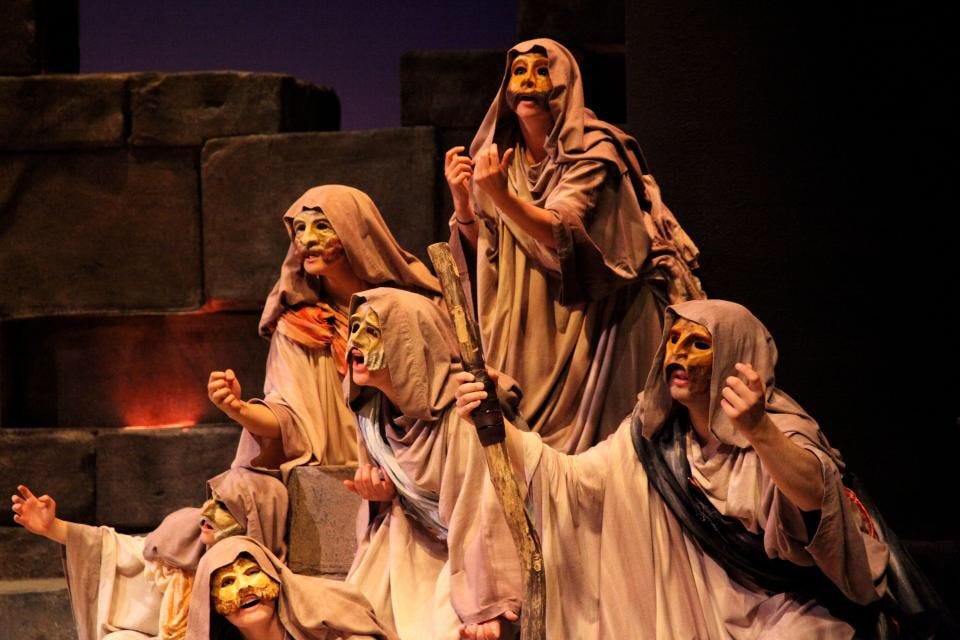
Art’s nice, right? A nice civilised thing to consume or maybe even make when we’ve paid our bills and finished the laundry.
But what if art was far more important than that? What if it was actually a metaphysical practice—the way our species has been bringing the world into being, manifesting its cosmovision, since our dawning days? Since way before religion or science existed? What if modern culture’s weirdo relegation of art to galleries and theatres is a key part of why our world is falling apart?
Because the creative imagination is the glue that holds the material world together, but we’ve convinced ourselves it’s just a luxury.
I laid out this idea last time I wrote to you. This time, let’s get practical. If we’re willing to entertain the idea that the world is a work of art, and we are each artists intimately involved in co-creating it, and living this way is how we hold the cosmos together… what do we actually do about that? How can we live into the opportunity to sculpt a world worth living in, all day every day?
Step one: Act
When I say “act”, you might conjure two meanings that feel quite distinct, even contradictory:
Take action; do something.
Play a part; pretend (perhaps for artistic purposes) to be someone or something you’re not.
Very different things, right? One means taking action in the real world. The other means making believe in an imaginary world.
Today, I’m going to suggest that these versions of acting have more in common than we tend to think. That in fact, their apparent difference springs from modernity’s mistake about what “the real world” is—this fallacy that it’s inert and objective, instead of a work of imagination that requires our artful and active participation.
Then I’m going to suggest how we can act, all day every day, in a way that feels more imaginative and empowering and alive—a way that remembers that all the world’s a stage, and we’re players in an unfolding imaginative story.
[Of course, because I’m me, I can’t do this without retracing millennia of cultural history. If you want to skip that, feel free to jump straight to the life hack at the end. I never thought I would type the words “life hack”, but there you go.]
Backstory
To illustrate the deep connection between the two versions of acting I’ve laid out above, and how they began to separate, let’s go back to the origins of theatre. This diagram of the Western world’s first theatre, the Theatre of Dionysus at the Acropolis, can tell us a lot:
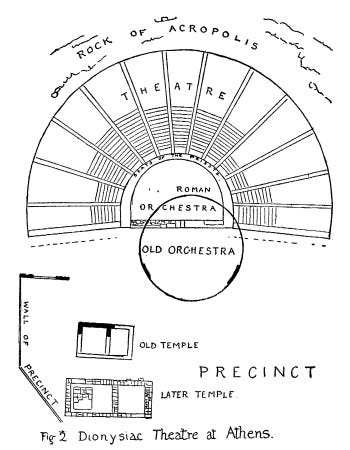
This shows the theatre’s layout, including the earliest architecture and later additions made by successive civilisations right up to the Romans—almost a millennium of accreting theatrical architecture. The most instructive part for our purposes today is the circle that says “old orchestra”.
This isn’t the part where the orchestra used to play. That’s a much later adaptation of the word.
No, “orkhestra” just means “a circular space”, and this circular space is where a chorus used to dance. It’s labelled “old” because it’s way older than the stage. The dancing of a chorus originated in the mists of time, centuries before anything called theatre existed.
Before the Athenian city-state was so much as a twinkle in a statesman’s eye, groups of up to fifty men and boys would gather in the countryside every spring to sing and dance in circular formations in honour of Dionysus, a god of, among other things, death, rebirth, and the unruly fertility of the living world. This was a rural practice of a rural, agricultural people, dancing for a good harvest.
They needed a good crop, as a matter of life and death. And they knew that the weather and the living world were controlled by unseen forces, which they understood as gods. So what did they do? They didn’t throw up their hands and concede powerlessness. Nor did they go into micro-manage mode and try to buckle the land to their desires through extractive land-management practices. Instead, they took action by opening their imaginations—the glue that holds the material world together.
They stood in the danger and uncertainty of incarnate life, and they found a form of behaviour—collective song and dance—that expanded what seemed possible in that life. That brought in the felt sense of eternity, to cushion the terrors of time.
Before we look at how these old choruses morphed to give us the artform of theatre, there are a few things I want to notice about the way they danced:
The circle they danced in was flush to the ground. An old orkhestra was never raised on a stage, because though people would gather to watch, spectating wasn’t the point. The point was the doing, the participation.
The circular shape was important, too. At the centre of the circle, there was an altar—a kind of lightning rod for the god’s energy. So the most powerful and important part of the space was its middle—a point any gathered spectators couldn’t even see. And whatever happened there would ripple out cleanly into the rest of the world, which stood at the same level as the circle.
Rites like these were called “dromena”, which comes from the verb “draō”, meaning “to do, act, or perform”. That name higlights something very important: These weren’t just adornments of reality; they were forms of action. They were meant to have an effect. Whatever change occurred inside the circle was very much intended to ripple out beyond it, into the everyday world.
But the people’s relationship with the divine was soon to change. Proto-statesmen would soon start enacting something like democracy—a system of governance that seemed increasingly to bring decision-making out of divine hands and into human ones. And it’s against this backdrop of emergent democracy that the new artform of drama was born out of the dromena.
(Let’s pause a moment to note here that this word, “drama”, also emerges out of the verb “draō”. So in both of these versions of acting, we have this sense of doing something. Of taking action.)
How exactly did the dromena give way to drama? This is one of the big questions in classical scholarship. One story tells us that it happened when a man named Thespis stepped out of the chorus and began to address the audience in character, giving every future thespian their job title.
The truth is more complex and nuanced. It’s about urbanisation and power and those changing relationships with the divine that I mentioned. Books and books have been written about this, but the piece I want to focus on today is this: As the ritualised action of the dromena gave way to the high art of drama, one of the main changes was the sudden emphasis on an audience.
Remember what I said about the flat structure of the orkhestra, and its most important point being its dead centre. Now check out this photo of the Theatre of Dionysus at the Acropolis (the same theatre you saw in diagram form above):
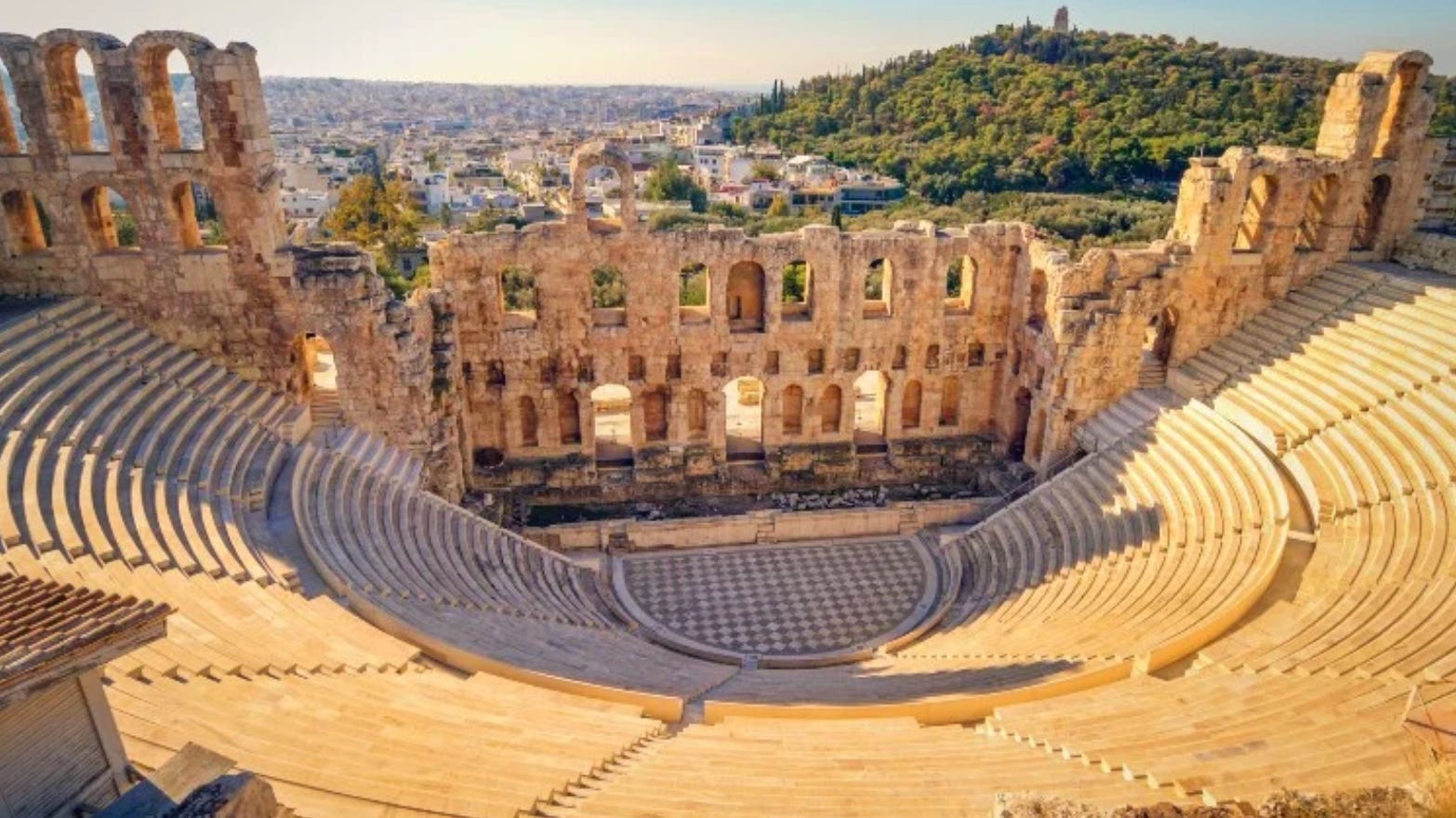
Check out those seats! And the way the circle has changed to a semicircle, so that its most important part is not the centre but the front edge, where the actors play for the spectators.
Suddenly, the most important part of all this isn’t contact with a god, but performance for humans.
In fairness, I should note that the stone seats were built later, by the Romans. The Greeks had a wooden version. But the audience seating was very important for the Greeks, too. In fact, the seats were such an important part of what was to unfold here—the artform that was to flourish here—that they gave it its name. “Theatre” means “a place for viewing”. The new artform of theatre would be defined by those seats, by the fact of having an audience.
Let’s consider what it might have been like to sit on those fancy seats at the fancy new theatre, watching a stage that at some point came to be raised off the ground, out of the level of ordinary life. You would have been crunched in with thousands of other viewers, listening to their breathing, smelling their bodies, unavoidably exposed to their incarnate reality. You would have been sitting passive in a smelly and bodily world, watching people act—be active—all the way down there, on the stage. The whole architecture heightened the perceived difference between audience and actors. It seemed to posit two separate worlds: that one down there on the stage, imaginary, fictional, determined by the actions of the players. (And increasingly home to the most remarkable creative work, by the likes of Aeschylus and Sophocles and Euripides.) This one out here in the audience real, factual, not imaginal or imaginary.
Now, the Ancient Greeks were an astonishingly alive and alert people, intellectually and creatively. They seem to have been able to hold the tension of these posited multiple layers of reality, without getting lazy. They seem to have been able to watch drama and still remember, when they emerged from the theatre, that they too—just like the characters in drama—were living in a world infused with spirit; a world in which imagination was part of the fabric of reality. (I’m saying this because when they stepped out of the theatre and into the political architecture of the Acropolis, they maintained a remarkable amount of ritualised contact with the greater-than-human forces that they understood as gods.)
But it seems to me at least possible that the physical architecture the Greeks built in the form of the theatre began to pave the way for the very lazy attitude we have to the purported levels of reality today. This might have been the beginning of our belief that art takes place in a make-believe world that is supplementary to everyday reality. A luxury. A nice extra. Separate from the real world, which is inert and objective.
And this—this—is where the whole world starts to fall apart. When we tell ourselves that it’s only fictional worlds that are held together by the creative imagination. That everything else is inert and objective and factual.
Life hack, I guess?
I am very surprised to find myself writing the words “life hack,” and yet that’s what this feels like.
Inhabiting the world as what it is—a work of art, a constant unfolding of imagination—means closing the gap between these two versions of “acting”. It means giving up this pretence that there is any level of reality that isn’t shaped by our creative imaginations.
Here’s a very powerful way to do this:
Remember that in fact, there is always an audience.
Even choruses dancing in their flattened circles, focusing on participation, not performance—even they knew that they were being watched. Even they were using the internalised sense of the eyes of others to infuse their actions with power and meaning and beauty, enabling them to bring forth a world that was more meaningful and beautiful and imaginally alive.
It’s just that the eyes on them didn’t require any human architecture, because they were other-than-human.
In the Ancient Greek (and pre-Ancient Greek) mind, this primary audience was understood to be the gods. That was the whole point of ritual dances like those of a chorus: to offer something to the watching gods.
And if the word “god” troubles you or leaves you cold, just imagine that your audience is something, anything, bigger than you, whose presence makes you want to live more fully and meaningfully. It might be the lives of the plants and animals who surround you and make your life possible, by silently giving up their own lives to feed and shelter you. (This thought very much informed by my recent work with Adam Wilson.) It might be your ancestors—all those who fought to survive so that you can live today. It might be your living loved ones. It might be the generations that will follow you.
Whatever you choose, the invitation is to internalise a sense that what you do matters, the actions you take matter. Because something bigger than you is watching. Because in fact, you too are a player in an ever-unfolding work of imagination, and some of that imagination has been pinched off to live in your own psyche and soul.
In every minute of every day, there is the option not to simply rattle through rote behaviours. To feel into the actions that might most delight that invisible audience, who are rooting for us to pull a good show out of this drama we’re living through.
Oh I relate to these reflections Ellie. I’m currently in England, catching up with family and friends, which means looking through lots of old family photo albums. What hits me is how these collections are often really cut down to one or two generations, sometimes to one or two people! And so many conversations are practical, pragmatic, here and now, lacking in curiosity even about my life and the lives of my children and grandchildren in Australia.
Ive been puzzling over this apparent disinterest, and writing about it. This morning I wrote a scene about being offered a beautiful family photo album to look at and how imagination is necessary to bring it to life, to see the relationships in a lived way. I began to see how this act of imagining is what gives contemporary family a sense of connection to place and groundedness within a family line that has a past and a future.
But it only has a future if we take that imaginative step, and act in ways that value our future generations. If that imaginative and creative leap is ignored or fails to happen, these old photos are merely showing strangers. In many was they confirm that we are isolated individuals in a harsh and forgetful word.
This process is especially challenging when the family has lived through some kind of migration or major crisis, which disrupts and looses the old connectedness to place and people. And this is a major issue today because there is so much mobility around the world - through migration, displacement, economic mobility, war and climate exile.
And that was the beauty of writing my scene. Because I began to see how the the labour, the work, of making the album, saving it when someone dies, passing it to others on by bringing the photos to life, by telling stories, by interpreting the photos to younger generations, is what makes a family and its line. A family only exists through these acts of keeping the record. And they only have meaning if the action unfolds through an imaginal world, which is not long seeable in the pragmatic here and now. It is a metaphysical practice.
This is a fascinating read Ellie. I noticed as I kept reading the word “watched” in the piece that I initially felt hostile to the word. To be watched: scrutinized, surveilled, criticized, inside the panopticon, spied upon . . . To reach the closing and find myself able to exhale at the idea of a watching that came from the All, from Spirit, from Being, a watching that included me in its process and yet could witness me as a being, muddling along, trying to make something decent of the time I have here . . . just that one word and my body’s response ratified so much of what you’re calling forth in this piece. Thank you!